Key takeaways:
- Start with 1:5 if you are new to cold brew concentrate.
- Use coarse ground coffee and steep for about 12–24 hours.
- Dilute the concentrate before drinking it.
Ratio for cold brew concentrate is usually 1:4 to 1:5. That means 1 gram of coffee for every 4 to 5 grams or ml of water.
Cold brew concentrate can be confusing because it is not meant to taste balanced straight from the jar. It is a strong coffee base.
This guide will help you make a steady batch, use less guesswork, and fix cold brew that tastes too bitter, weak, sour, or muddy.


Quick answer
The best starting ratio for cold brew concentrate is 1:5. Use 100 g coffee with 500 ml water, or 200 g coffee with 1 liter water.
Need a Few Simple Tools for Better Home Brewing?
Browse practical Amazon Basics coffee and kitchen gear for grinding, brewing, storing, and setting up your everyday coffee corner.
Paid link. As an Amazon Associate we earn from qualifying purchases.
A stronger concentrate can use 1:4. A lighter concentrate can use 1:6. The National Coffee Association lists cold brew at 1:4 to 1:5, brewed at room temperature or cooler, with about 12 hours of contact time.
Your result can change because of:
- Bean freshness
- Roast level
- Grind size
- Water taste
- Steep time
- Fridge or room-temperature brewing
- How much water, milk, or ice you add later
What does cold brew concentrate ratio mean?
Coffee-to-water ratio means how much coffee you use compared with water.
Example: 1:5 means 1 part coffee to 5 parts water.
Cold brew concentrate means a strong cold brew base that you dilute before drinking.
Dilution means adding water, milk, or ice melt to make the drink lighter.
Extraction means how much flavor water pulls from coffee.
Steep time means how long coffee grounds sit in water.
Best ratio for cold brew concentrate
Start with 1:5. It is strong enough to dilute, but not as heavy as 1:4.
| Ratio | Coffee for 500 ml water | Coffee for 1 liter water | Strength | Best for |
|---|---|---|---|---|
| 1:4 | 125 g | 250 g | Stronger | Milk drinks, bold iced coffee |
| 1:5 | 100 g | 200 g | Balanced concentrate | Beginner-friendly batches |
| 1:6 | 83.3 g | 166.7 g | Lighter concentrate | Less dilution later |
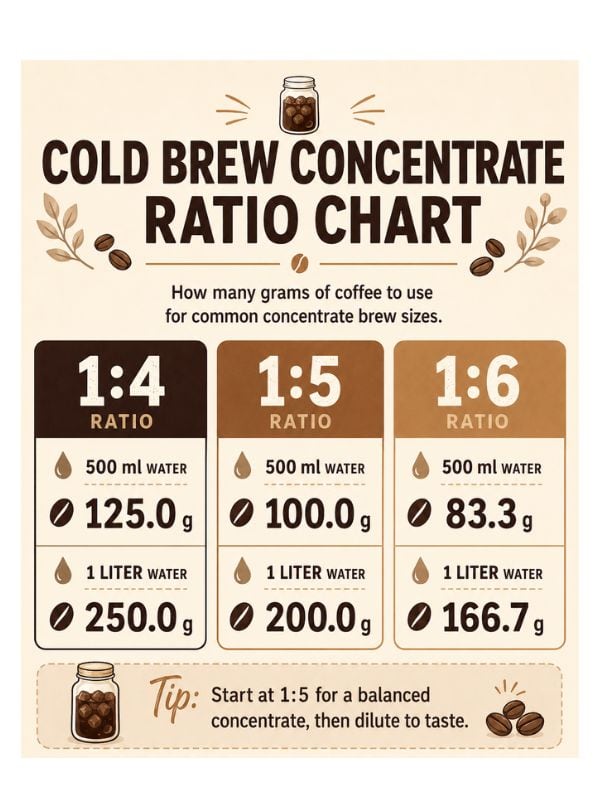
The Coffeenatics coffee-to-water calculator uses simple ratio math: water = coffee × ratio and coffee = water ÷ ratio. That makes it useful when you want to scale a concentrate batch up or down.
How we calculate
We convert units to a base system (grams for coffee, milliliters for water) and apply:
water = coffee × ratiocoffee = water ÷ ratioratio = water ÷ coffee
Then we convert back to your chosen display units (1 oz = 28.3495 g; 1 fl oz = 29.5735 ml) and round to 1 decimal place.
Easy beginner recipe
Use this recipe first:
- 100 g coarse ground coffee
- 500 ml water
- Steep 12–18 hours
- Strain
- Dilute before drinking
This gives you a 1:5 cold brew concentrate.
Cold brew concentrate vs ready-to-drink cold brew
Cold brew concentrate uses more coffee for the same amount of water. Ready-to-drink cold brew uses more water, so you can drink it with little or no dilution.
| Type | Common ratio | Dilute before drinking? | Example |
|---|---|---|---|
| Cold brew concentrate | 1:4 to 1:5 | Yes | 100 g coffee + 400–500 ml water |
| Lighter concentrate | 1:6 to 1:8 | Usually | 100 g coffee + 600–800 ml water |
| Ready-to-drink cold brew | About 1:10 to 1:12 | Usually no | 83–100 g coffee + 1 liter water |
Sample Coffee gives 1:12 by weight as a standard cold brew ratio, with 83 g coffee for 1 liter water. That is much lighter than a concentrate recipe, so it works better for cold brew you drink straight or over ice.

How to dilute cold brew concentrate
Start with a simple 1:1 dilution:
- 1 part concentrate
- 1 part water or milk
- Ice, if desired
For one glass, try:
| Serving style | Concentrate | Add | Result |
|---|---|---|---|
| Strong iced coffee | 60 ml | 60 ml water or milk | Bold |
| Balanced iced coffee | 60 ml | 120 ml water or milk | Smooth and lighter |
| Light iced coffee | 60 ml | 180 ml water or milk | Gentle |
| Over ice only | 60–90 ml | Ice | Strong at first, lighter as ice melts |
Stumptown suggests starting with equal parts cold brew concentrate and water over ice. OXO gives a serving guide of 60 ml concentrate with 120–180 ml water or milk, plus ice.

Step-by-step cold brew concentrate recipe
1. Choose your ratio
Use:
- 1:5 for a balanced first batch
- 1:4 for a stronger base
- 1:6 if 1:5 tastes too heavy
Make a smaller batch first. Cold brew uses more coffee than hot brewing, so testing helps reduce waste.
2. Grind the coffee coarse
Use coarse ground coffee.
Coarse grind means bigger coffee pieces, like rough sea salt.
Cold brew sits in water for many hours. A finer grind may make the drink muddy or harsh. Sample Coffee recommends coarse grind for cold brew and notes that finer grinds can lead to over-extraction and a muddy texture.
3. Add coffee and water
Use a clean jar, pitcher, French press, or cold brew maker.
For a 1:5 beginner batch:
- Add 100 g coarse ground coffee.
- Add 500 ml water.
- Stir gently.
- Make sure all grounds are wet.
The National Coffee Association also advises adding water gradually and stirring gently so the grounds are moistened.
4. Steep
Use this range:
- 12 hours for a lighter concentrate
- 16–18 hours for a fuller concentrate
- Up to 24 hours if your recipe or brewer calls for it
The National Coffee Association lists about 12 hours of contact time for cold brew. OXO recommends 12–24 hours at room temperature for its cold brew maker method.
5. Strain
Strain through one of these:
- Cold brew filter
- French press
- Fine mesh sieve
- Cloth filter
- Paper filter after the first strain
If your drink tastes gritty, strain it again through paper.
6. Dilute before drinking
Do not judge the concentrate straight unless you like very strong coffee.
Start with:
- 60 ml concentrate
- 60 ml water or milk
- Ice
Then adjust from there.
7. Store in the fridge
Store your concentrate in a sealed container in the refrigerator.
OXO says its cold brew concentrate can be sealed and stored in the fridge for up to two weeks. For best taste at home, smaller batches are safer until you know how fast you finish it.
No scale? Use this fallback
A scale is better for cold brew concentrate because the coffee dose is large.
Without a scale, use this rough guide:
- 1 level tablespoon ground coffee is often about 5–7 g
- For 500 ml water at 1:5, use about 15–20 level tablespoons
- For 1 liter water at 1:5, use about 30–40 level tablespoons
This is less accurate. Spoon weight changes with roast level, grind size, and how full the spoon is.
Do this instead: use the same spoon, level it each time, and write down your recipe.


No thermometer?
You do not need hot water for cold brew concentrate.
Use:
- Cold water
- Room-temperature water
- Filtered water, if your tap water tastes strong
The National Coffee Association lists cold brew temperature as room temperature or cooler.
No grinder?
Ask your café or roaster for:
“Coarse grind for cold brew concentrate.”
If buying pre-ground coffee, look for:
- Cold brew grind
- French press grind
- Coarse grind
Avoid espresso grind. It is usually too fine for cold brew concentrate.


Common mistakes
- Using a ready-to-drink ratio for concentrate.
Do this instead: use 1:4 to 1:5. - Drinking concentrate straight and thinking it tastes wrong.
Do this instead: dilute it first. - Grinding too fine.
Do this instead: use coarse grind. - Not wetting all the grounds.
Do this instead: stir gently after adding water. - Steeping too long without testing.
Do this instead: start with 12–18 hours. - Using random scoops.
Do this instead: weigh the coffee, or use the same level spoon each time. - Forgetting ice dilution.
Do this instead: make the drink a little stronger if you serve it over a lot of ice. - Making too much on the first try.
Do this instead: test a 500 ml batch first.
If your coffee tastes…
Bitter
Likely causes:
- Ratio is too strong
- Grind is too fine
- Steep time is too long
- Not enough dilution
Fixes:
- Move from 1:4 to 1:5 or 1:6.
- Grind coarser.
- Steep for fewer hours.
- Add more water or milk when serving.
Sour
Likely causes:
- Steep time is too short
- Grind is too coarse
- Coffee is very light roast
- Too much dilution
Fixes:
- Steep longer.
- Try 1:5 instead of 1:6.
- Grind slightly less coarse.
- Use less water or milk when serving.
Weak or watery
Likely causes:
- Too much water or milk was added
- Too much ice melted
- Ratio is too light
- Coffee dose was too low
Fixes:
- Dilute less.
- Move from 1:6 to 1:5.
- Move from 1:5 to 1:4 if you want a stronger base.
- Serve over fewer ice cubes.
Muddy or gritty
Likely causes:
- Grind is too fine
- Filter is too loose
- Coffee dust passed through
- The brew was stirred too hard before straining
Fixes:
- Use coarser grind.
- Strain twice.
- Use a paper filter after the first strain.
- Pour slowly.
Harsh or astringent
Astringent means dry or rough in the mouth.
Likely causes:
- Over-steeping
- Fine grounds
- Too much coffee for the water
- Not enough dilution
Fixes:
- Shorten steep time.
- Use coarser grind.
- Move toward 1:5 or 1:6.
- Dilute more before drinking.
Next steps
- Coffee Calculators for Smarter Brewing
Use this hub if you want more tools for coffee ratio, cooling, milk temperature, and coffee cost. - Coffee to Water Ratio Calculator
Use this to calculate your cold brew concentrate batch by coffee amount, water amount, or ratio. - Coffee Brewing Calculator
Use this if you want a more advanced brewing tool that considers brew method, roast level, and blends. - Coffee Grind Size Chart: Complete Brewing Guide
Use this if your cold brew concentrate tastes muddy, bitter, sour, or weak. - How to Filter Cold Brew Coffee: 4 Proven Methods
Use this if your concentrate tastes gritty or has too much sediment. - Best Iced Coffee Maker
Use this if you want a dedicated cold coffee setup for regular batches.
How we know
- The main ratio range comes from the National Coffee Association, which lists cold brew at 1:4 to 1:5.
- The calculator guidance follows Coffeenatics’ own ratio formula: water equals coffee multiplied by the ratio, and coffee equals water divided by the ratio.
- The steep-time range uses the National Coffee Association’s about 12-hour contact time and OXO’s 12–24-hour cold brew maker instructions.
- The dilution section uses serving examples from Stumptown and OXO.
- The troubleshooting advice uses careful wording because taste changes with beans, grind, water, steep time, filtration, ice, and dilution.
Gear that can help
You can make cold brew concentrate with a clean jar and a filter.
If you make it often, these tools can help:
- If your batches taste different each time: consider a small digital scale.
- If your concentrate tastes muddy: consider a burr grinder with coarse settings.
- If straining feels messy: consider a cold brew maker with a built-in filter.
- If your tap water tastes strong: consider a simple water filter.
- If you batch for busy mornings: consider an airtight glass bottle for fridge storage.
Start with the ratio first. Then adjust grind, steep time, and filtration.
References
Coffeenatics. (n.d.). Coffee brewing calculator: Advanced tool for coffee enthusiasts. https://coffeenatics.com/coffee-calculators/coffee-brewing-calculator/
National Coffee Association. (n.d.). Cold brew coffee. https://www.aboutcoffee.org/brewing/cold-brew-coffee/
OXO. (n.d.). How to use the OXO cold brew coffee maker. https://www.oxo.com/blog/coffee-and-beverages/how-to-use-the-oxo-cold-brew-coffee-maker?srsltid=AfmBOooPlGeRenDISGGVBzzMM8WTd5WLNwa7el-EquvtfhOSFscc4z5U
Stumptown Coffee Roasters. (2019, June 3). Cold brew concentrate crash course. https://www.stumptowncoffee.com/blogs/news/cold-brew-concentrate?srsltid=AfmBOoqLzOIzNGPu8Fku0odXsWJq1jIJNfsak5eWrmqIbkna-mMBbqIa
Final thoughts
The best ratio for cold brew concentrate is a starting point. Use 1:5 first if you want a balanced concentrate that is easy to dilute.
Use 1:4 if you want a stronger base for milk. Use 1:6 if your concentrate feels too heavy. Keep the recipe steady for a few batches, and your cold brew will be easier to repeat.