Key takeaways
- Burr grinders usually make more even grounds, which makes brewing more repeatable.
- Blade grinders can still make drinkable coffee, but they tend to create mixed particle sizes, so flavor can be less consistent.
- For espresso and precise pour-over, a burr grinder is usually the more practical choice. Grind size control matters more in those methods.
Burr grinder vs blade grinder is really about one thing: how much control you want over your coffee. If your brew tastes balanced one day and rough the next, the grinder may be part of the problem.
If you feel overwhelmed by coffee gear advice, this guide will simplify the choice. You will learn which grinder fits your brew method, budget, kitchen space, and daily routine so you can get more consistent cups, less waste, and better flavor.


Quick answer: Burr Grinder vs Blade Grinder)
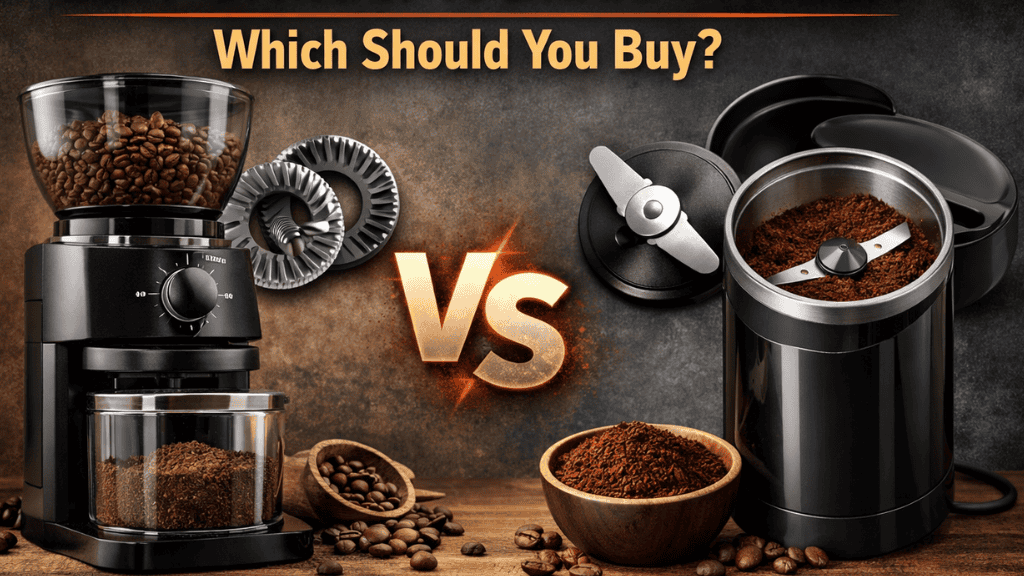
A burr grinder grinds coffee between two burrs (two hard cutting surfaces). A blade grinder chops beans with a fast spinning blade. Burr grinders usually give you more even particle sizes and clearer grind settings, while blade grinders are cheaper and simpler but less precise.
For most home brewers, a burr grinder is the better long-term choice. For very tight budgets, occasional cold brew, or casual use, a blade grinder can still work. Results also change based on the beans, roast level, water temperature, grind setting, and brew method.
Need a Few Simple Tools for Better Home Brewing?
Browse practical Amazon Basics coffee and kitchen gear for grinding, brewing, storing, and setting up your everyday coffee corner.
Paid link. As an Amazon Associate we earn from qualifying purchases.
Best choice by situation
- You want better flavor and repeatability: choose a burr grinder
- You are on a very tight budget: a blade grinder can be enough
- You brew espresso often: choose a burr grinder
- You make pour-over or AeroPress a lot: choose a burr grinder
- You want the smallest setup: a manual burr grinder is often a strong option
- You only make occasional French press or cold brew: a blade grinder can be usable
That guidance follows how grind uniformity and grind adjustment affect extraction across brew methods.
What is a burr grinder?
A burr grinder crushes beans between two burrs. The distance between the burrs controls the grind size.
That matters because particle size affects extraction (how much flavor you pull from coffee). When the grounds are more even, brewing is easier to repeat. Burr grinders are also easier to adjust from fine to coarse for different methods.
What is a blade grinder?
A blade grinder uses a spinning blade to chop beans.
It is simple, cheap, and compact. But because the beans are chopped instead of pushed through a fixed gap, the output often includes both larger chunks and very fine particles. That can make brewing less predictable.
Fines (very small coffee particles that extract faster than larger pieces)
Burr grinder vs blade grinder at a glance
| Feature | Burr grinder | Blade grinder |
| How it works | Crushes beans between burrs | Chops beans with a spinning blade |
| Grind consistency | Usually more even | Often less even |
| Grind size control | Clear settings on many models | No true setting, mostly time-based |
| Best for | Most brew methods, especially espresso and pour-over | Budget use, casual drip, some French press, some cold brew |
| Espresso suitability | Usually the practical choice | Usually not ideal |
| Noise | Often moderate | Often loud and sharp |
| Cleanup | Usually straightforward | Often simple, but grounds can cling to the bowl |
| Price | Usually higher | Usually lower |
| Portability | Manual burr grinders travel well | Often compact too |
| Learning curve | Moderate | Easy |
Why grind consistency matters
Coffee extraction depends on surface area and contact time. Smaller particles extract faster. Larger particles extract slower. When one batch has many different sizes, water can over-extract some particles and under-extract others in the same brew.
The Specialty Coffee Association uses brewing targets such as 92–96°C water contact temperature and a typical “ideal” zone around 18–22% extraction and 1.15–1.45% beverage strength for brewed coffee. Those targets do not prove one grinder is always “best,” but they do show why repeatable grind size matters when you want repeatable cups.
Which grinder is better for each brew method?
| Brew method | Better choice | Why |
| Pour-over | Burr grinder | Flow rate and drawdown respond strongly to grind consistency. |
| AeroPress | Burr grinder | It helps when adjusting time, dose, and grind. |
| French press | Burr grinder preferred; blade usable | Coarse, more even grounds usually brew more cleanly. |
| Espresso | Burr grinder | Fine adjustment matters much more here. |
| Moka pot | Burr grinder | You need a controlled fine-to-medium-fine grind. |
| Cold brew | Burr grinder preferred; blade usable | Coarse grinding is easier to repeat with burr settings. |
Is a burr grinder really worth it?
Usually, yes, if you brew often and care about repeatability.
A burr grinder is more likely to be worth the money if:
- you brew at home most days
- you switch between brew methods
- you use better beans and want to waste less of them
- you care about dialing in flavor
It may matter less if:
- you brew only once in a while
- you mostly make cold brew
- your budget is extremely tight
- you are still exploring whether home coffee is a real habit
The key value is not only “better coffee.” It is also easier adjustment, less guesswork, and a better chance of getting the same result again tomorrow.


Can a blade grinder make good coffee?
Yes, in many cases, it can make decent coffee.
But the question is not only whether it can make a good cup once. The bigger issue is whether it can make a similar cup again and again with less effort. Blade grinders tend to be less repeatable because there is no true grind setting and the particle sizes are more mixed.
If you use a blade grinder, it usually works better with more forgiving methods like:
- French press
- immersion-style AeroPress
- cold brew
- basic drip coffee
It is usually a weaker fit for espresso and tight, recipe-heavy pour-over.
Manual burr grinder vs electric blade grinder
This is one of the most practical budget comparisons.
Choose a manual burr grinder if:
- you want better grind consistency
- you have a small kitchen
- you do not mind hand grinding
- you want a travel-friendly option
Choose an electric blade grinder if:
- cost is your main priority
- speed matters more than precision
- you only brew casually
For many home brewers on a budget, a manual burr grinder is the better long-term compromise. It often gives you the grind benefits of burrs without the price of an electric burr grinder. The trade-off is effort and time.
Which grinder wastes less coffee over time?
A burr grinder may help reduce waste because it makes adjustment easier and results more repeatable. That does not mean every user will waste less coffee, but it can reduce the number of disappointing brews when you are trying to dial in a recipe. This is an inference from grind uniformity and adjustment control, not a universal measured guarantee.
If you buy specialty beans, this matters more. Better beans cost more, so inconsistent grinding can feel more expensive.
Common mistakes
- Using a blade grinder for espresso.
Do this instead: use a burr grinder with fine adjustment steps. - Grinding too long in a blade grinder.
Do this instead: pulse in short bursts and shake between pulses. - Changing beans without adjusting grind.
Do this instead: expect to tweak grind when roast level or bean age changes. - Pouring fully boiling water straight onto coffee every time.
Do this instead: brew near 92–96°C, or rest boiling water for about 30–60 seconds first. - Guessing the dose with random scoops.
Do this instead: use a scale when possible. If not, use the same spoon every time. - Buying good beans but keeping a poor grind match.
Do this instead: match coarse grinds to immersion methods and finer grinds to faster methods. - Assuming bitter means stronger.
Do this instead: check grind size, water temperature, and brew time first.
Beginner-safe process
If you have a burr grinder
- Pick your brew method.
For one common home burr grinder range, fine settings are used for espresso, mid settings for pour-over and drip, and coarse settings for French press and cold brew. Settings differ by model, so treat that as a starting example, not a universal chart. - Start with a simple ratio.
For many filter brews, start around 1:15 to 1:17 coffee-to-water by weight. The SCA control chart includes ratios in this range. - Heat water to a safe range.
Aim for 92–96°C. - Brew and taste.
- Adjust one thing at a time.
If bitter, grind a little coarser. If sour, grind a little finer. If weak, increase dose or reduce water slightly.
If you only have a blade grinder
- Use short pulses, not one long blast.
- Shake the grinder between pulses.
- Stop and check often.
- Choose forgiving brew methods.
- Keep your recipe simple and consistent.
This will not turn a blade grinder into a burr grinder, but it can make results more usable.
Fallbacks
No scale:
Use 1 tablespoon of coffee = roughly 7 to 8 grams as a rough starting point. Scoop size and bean density vary, so accuracy will be lower than weighing.
No thermometer:
Bring water to a boil, then let it rest about 30 to 60 seconds before brewing. This often lands near the usual home brew range, but the exact number depends on kettle shape, room temperature, and water volume.
No grinder:
Ask your café or roaster to grind for your method:
- pour-over: medium
- French press: coarse
- moka pot: medium-fine
- espresso: espresso-fine
Pre-ground coffee usually loses freshness faster after opening, so try to use it promptly.

If your coffee tastes…
Bitter
Likely causes:
- grind too fine
- brew time too long
- too many fines
- water too hot
Fixes:
- grind coarser
- shorten brew time
- reduce agitation
- brew within the 92–96°C range
Sour
Likely causes:
- grind too coarse
- brew time too short
- water not hot enough
- under-extraction
Fixes:
- grind finer
- brew a little longer
- brew hotter within the safe range
- improve grind consistency
Weak or watery
Likely causes:
- too little coffee
- too much water
- grind too coarse
- under-extraction
Fixes:
- increase dose
- lower the water amount
- grind a bit finer
- stay closer to 1:15 to 1:17 for many filter brews
Harsh or astringent
Astringent (a dry, rough feeling in your mouth)
Likely causes:
- too many fines
- over-extraction
- uneven flow through the coffee bed
Fixes:
- grind more evenly
- grind slightly coarser
- pour more evenly
- reduce brew time or agitation
Frequently Asked Questions
-
Is a burr grinder better than a blade grinder?
Usually yes, if you care about repeatability, easier dialing in, and better grind control. A blade grinder can still work, but it tends to be less precise.
-
Can you use a blade grinder for espresso?
You can try, but it is usually not a good fit. Espresso responds strongly to fine grind changes and more uniform particles.
-
Is a blade grinder okay for French press?
It can be okay for casual use. But a burr grinder usually gives a more even coarse grind and a cleaner result.
-
What is the cheapest way to get more even coffee grounds?
Often, it is buying a manual burr grinder instead of moving from one blade grinder to another.
-
Should I buy a manual burr grinder or an electric blade grinder?
If cup quality matters more, choose the manual burr grinder. If speed and lower price matter more, choose the electric blade grinder.
Gear that can help
If you want better consistency
- Entry-level burr grinder
Good for most home brewers who want easier grind control. - Manual burr grinder
Useful for small kitchens, lower noise, and travel.
If you brew pour-over often
- Gooseneck kettle
Helps you pour more evenly. - Digital scale
Helps make your dose and water amount repeatable.
If you are still using a blade grinder
- Small sieve or shaker setup
This can help a little, but it adds work and cleanup.
I would keep the upgrade path simple: if you can change only one piece of gear, many home brewers choose the grinder first because grind control affects almost every brew method. That is a practical recommendation based on extraction guidance, not a promise that every setup will improve by the same amount.
How we know
- We used Specialty Coffee Association brewing targets for water contact temperature and common brewing ranges.
- We used coffee grinding references that explain why particle size and particle uniformity affect extraction.
- We used manufacturer guidance for one current burr grinder as an example of how grind settings map to brew methods. That example is useful, but not universal across all grinders.
- We used published literature noting that around 93°C is commonly treated as a useful brew target, while also noting that evidence for one exact “best” temperature is limited.
- We avoided hard claims where results depend on brew method, bean, or user technique.
Final thoughts on burr grinder vs blade grinder
For most people, burr grinder vs blade grinder comes down to this: do you want the lowest entry cost, or do you want easier control over flavor every day?
A blade grinder can get you started. A burr grinder usually gives you a better path to repeatable, balanced coffee across more brew methods. If your goal is café-quality coffee at home with less guesswork, a burr grinder is usually the stronger choice.
References
Batali, M. E., Cotter, A. R., Frost, S. C., & Ristenpart, W. D. (2020). Brew temperature, at fixed brew strength and extraction, has little impact on the sensory profile of drip brew coffee. Scientific Reports, 10, Article 18276.https://pmc.ncbi.nlm.nih.gov/articles/PMC7536440/
Modern Process Equipment. (n.d.). Does my coffee grinder affect my coffee’s taste?https://www.mpechicago.com/wp-content/uploads/2019/12/coffee_con_2012a-1.pdf
Modern Process Equipment. (n.d.). Gaining ground.https://www.mpechicago.com/wp-content/uploads/2019/12/gainingground.pdf
Specialty Coffee Association. (2017). Brewer program – minimum certification requirements.https://sca.coffee/s/2017-SCA-CHB-Program-Requirements-ja56.pdf
Specialty Coffee Association. (2019). SCA brewing chart.https://static1.squarespace.com/static/587af1d4db29d69a1a226b95/t/60aece65e4f2134d99f6e646/1622068839009/SCA%2BBrewing%2BChart%2B-%2BRevised%2BMarch%2B2019-US-Letter.pdf
Specialty Coffee Association. (2021). SCA Standard 310-2021.https://coffeegeek.com/wp-content/uploads/2023/10/SCAGoldCupStandard.pdf
Slawinski, M., Liszka, M., & Rząca, M. (2023). Influence of flow rate, particle size, and temperature on espresso extraction kinetics. ResearchGate record.https://www.researchgate.net/publication/372741726_Influence_of_Flow_Rate_Particle_Size_and_Temperature_on_Espresso_Extraction_Kinetics